Lewis and his crew leave at sunrise reaching Logstown at 9 o’clock. It takes four hours to drag the barge over shallows there. Shortly after, Lewis appears frustrated when they encounter a worse ripple that requires a horse and ox to pull the heavy boat. He complains about the extravagant prices paid for this service.
A Bow or Neck Yoke
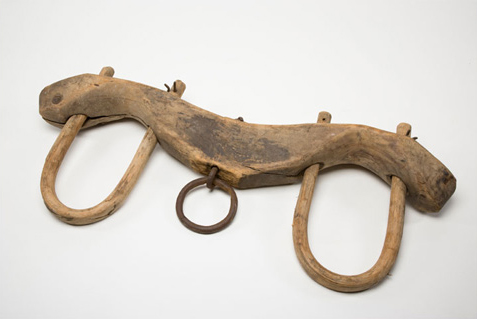
Called oxbows—a name lent long ago to a common feature of nearly every free-flowing watercourse, where a stream’s channel bends back upon itself—the two U-shaped pieces (usually hickory wands) are held snugly in place with metal keepers inserted through holes bored in the wooden bows. The tongue of a wagon or a chain from a sledge is fastened to the iron ring, which is suspended from a U-shaped iron rod called a staple. Many other designs utilizing the same principle have been used, but this is the one most often found in North American agriculture until the end of the 19th century.
Logstown Riffle
Set out at sunrise 2 miles ½ to a riffle got out and pulled the boat over it with some dificulty— 9 Oclock reched Logtown riffle unloaded and with much difficulty got over detain 4 hours.—
—Meriwether Lewis
Logstown was originally settled by Shawnees.
Extravagant Charges
supposed I had gotten over Logtown riffle but find ourselvs stranded again suppose it best to send out two or three men to engage some oxen or horses to assist us obtain one horse and an ox, which enabled us very readily to get over payd the man his charge which was one dollar . . . . the inhabitants who live near these riffles live much by the distresed situation of traveller are generally lazy charge extravegantly when they are called on for assistance and have no filantrophy or continence
—Meriwether Lewis
Ugly Rifts and Shoals
[Oct. 22, 1770]
The River from Fort Pitt to the Logs Town has some ugly Rifts & Shoals, which we found somewhat difficult to pass, whether from our inexperience of the Channel, or not, I can not undertake to say
—George Washington (22 October 1770)[1]Archer B. Hubert, “Washington’s ‘Tour to the Ohio’ and Articles of The Mississippi Company.” Ohio Archaeological and Historical Society Publications, (October 1908), 458.
George Washington’s diary provides one of the most accurate descriptions of early Ohio River boating conditions. Lewis had the advantages of a guide book and an experienced pilot. His primary disadvantage was the large size and heavy load of the barge (called boat, barge, and bateau but never keelboat). Washington made his journey in a canoe and was heading upriver when he wrote this day’s entry.
A Serpentine Course
The hills on either side of the ohio are from 3 to 400 feet which runing parrallel to each other keep the general course of the river, at the distance of about two miles while the river pursuing a serpentine course between them alternately washes their bases.— thus leaving fine bottom land between itself and the hills in large boddys, and freequently in the form of a simecicles or the larger segment of a circle or horseshoe form
—Meriwether Lewis
Checking Temperatures
Thermometer stood at seventy six in the cabbin the temperature of the water in the river when emersed about the same—
—Meriwether Lewis
Lieutenant Hooke’s Update
Pittsburg Sept. 2nd 1803
Sir [William Linnard]
. . . . the river is so very low that I am fearfull [Capt. Lewis] will not be able to prossecute his voyge untill it rises, nowithstanding he took the precaution to send two Waggon loads of his goods by land to Wheelin.
Ms. Hooke[2]Moses Hooke to William Linnard in Letters of the Lewis and Clark Expedition with Related Documents: 1783-1854, 2nd ed., ed. Donald Jackson (Urbana: University of Illinois Press, 1978), 119.
Moses Hooke was in charge of Fort Fayette during Lewis’s stay in Pittsburgh. At one point, Lewis nominated him to co-lead the expedition should Clark decline—see July 26, 1803.
Experience the Lewis and Clark Trail
The Lewis and Clark Trail Experience—our sister site at lewisandclark.travel—connects the world to people and places on the Lewis and Clark Trail.
Plan a trip related to September 2, 1803:
Notes
| ↑1 | Archer B. Hubert, “Washington’s ‘Tour to the Ohio’ and Articles of The Mississippi Company.” Ohio Archaeological and Historical Society Publications, (October 1908), 458. |
|---|---|
| ↑2 | Moses Hooke to William Linnard in Letters of the Lewis and Clark Expedition with Related Documents: 1783-1854, 2nd ed., ed. Donald Jackson (Urbana: University of Illinois Press, 1978), 119. |