Near this day, Lewis and his party[1]Traveling with Meriwether Lewis to Washington City is a Mandan delegation from the Knife River Villages: Chief Sheheke, his wife Yellow Corn, and their son. Speaking Mandan and French was interpreter … Continue reading travel on the Wilderness Road between Pineville and present Middlesboro, Kentucky. At the latter location, they meet notable veteran and politician Arthur Campbell who helps Sgt. Ordway publish his journal—and asks Lewis for a favor.
Arthur Campbell’s Favors
Fern Lake and Middlesboro, Kentucky c. 1935
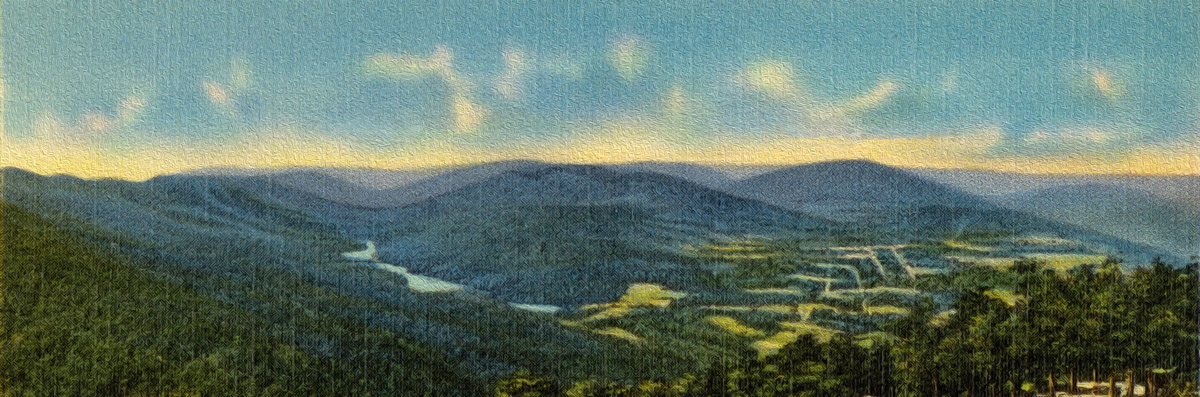
Stylized from a postcard entitled “View north from the Pinnacle, Cumberland Gap, Tenn., Va., Ky.” published by W. M. Cline Co., Chattanooga, Tennessee. Courtesy Boston Public Library Tichnor Brothers collection.
Kentucky. 20 Nov. 1806.[3]If this date is correct, then Ordway was likely traveling ahead of Lewis. Given Lewis’s typical pace of 20 miles per day, Lewis and his party likely arrived at Middlesboro on 22 November and … Continue reading
Rev Sir [Jedidiah Morse],
The bearer hereof being one of the party that attended Captains Lewis & Clark on their late tour up the Missouri and across to the Pacific ocean, and is in the possession of a journal kept by himself that may increase our knowledge of the western country; I have taken the liberty to advise him to apply to you for information & advice where he might make it useful to the public & at the same time be of some profit to himself. True it is that the Captains journal may be more full and correct, but as he has said that it will be at least 2 years, before his is ready for publication, in the mean time Mr. Ordway’s journal being published, it will serve as an introduction to the other larger work, and give much useful information that may be much needed, before that of the Captains can appear. Besides I understand that this journal has been examined and corrected by Lewis, and as far as it goes, gives a true statement of facts, as to the Geographical part of the journey. That which relates to animal, mineral & vegetable production, we must restrain our curiosity until the large work appears.
I am Rev Sir, being respectly your most obed Sert
Arthur Campbell[4]Arthur Campbell to Jedidiah Morse, Jedidiah Morse Papers, Box 1, folder “Correspondence 1801–1806,” Manuscripts and Archives Division of The New York Public Library cited in Kerry Oman, … Continue reading
The recipient of Campbell’s letter, Jedidiah Morse (23 August 1761–9 June 1826), was considered the father of American geography. His prior works included the 1784 school primer Geography Made Easy, the 1789 textbook American Geography, and his 1797 Universal Geography of the United States. Whether Ordway ever visited Morse remains unknown.[5]“Jedidiah Morse”, Wikipedia, en.wikipedia.org/wiki/Jedidiah_Morse.
Michaux’s Climbing Fern
Climbing Fern
Lygodium palmatum (Bernhardi) Swartz
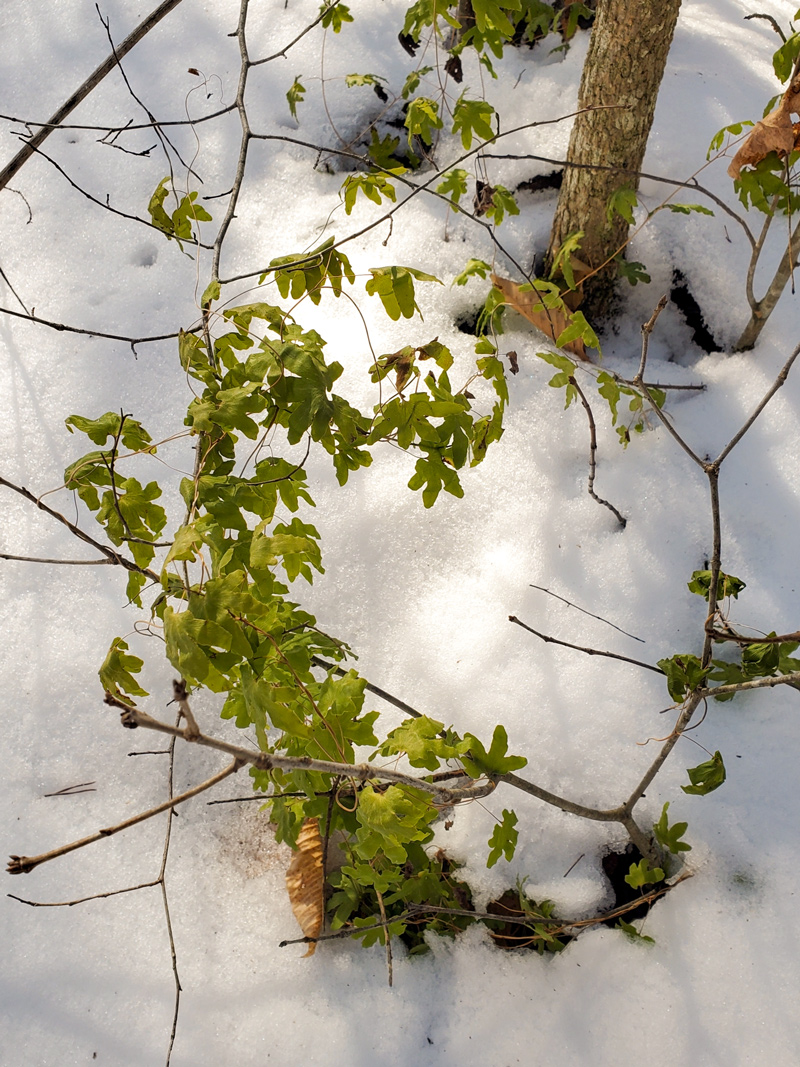
© 25 January 2025 by Terri Koontz. Permission to use granted under the Creative Commons CC0 1.0 Universal Public Domain Dedication license.
Thomas Jefferson’s first Western explorer, André Michaux, had little good to say about traveling on the Wilderness Road. He was, however, happy to find a plant new to science in the vicinity of Middlesboro.
Six miles from Middleton Gap, saw a climbing fern covering an area of over six acres of ground near the road. At this season when the Frost had produced ice from 3 to 4 inches thick, this plant was not at all injured by it.
—André Michaux[6]André Michaux, Journal of Travels into Kentucky: July 15, 1793–April 11, 1796 in Reuben G. Thwaites, Travels West of the Alleghanies (Cleveland: The Arthur H. Clark Co., 1904), 3:45, available at … Continue reading Lewis likely knew this plant when he approached Middlesboro in November 1806.
This plant would be commonly called American climbing fern, Harford fern, or Alice’s fern. It’s use as a Christmas decoration by early settlers led “to the first law protecting a plant species in the United States in 1869”.[7]“Lygodium palmatum”, Wikipedia, en.wikipedia.org/wiki/Lygodium_palmatum; “Lygodium palmatum”, North Carolina Extension Gardener Plant Toolbox, … Continue reading
Notes
| ↑1 | Traveling with Meriwether Lewis to Washington City is a Mandan delegation from the Knife River Villages: Chief Sheheke, his wife Yellow Corn, and their son. Speaking Mandan and French was interpreter René Jusseaume who brought one of his wives and two children. Expedition private François Labiche was included to translate between French and English. Finally, records indicate expedition sergeant John Ordway may have been serving as Lewis’s assistant. |
|---|---|
| ↑2 | “Arthur Campbell (Virginia soldier)”, Wikipedia, en.wikipedia.org/wiki/Arthur_Campbell_(Virginia_soldier); John Baker, “The Almost Published Journals of the Lewis and Clark Expedition”, We Proceeded On 40 No. 1 (February 2023): 9–10, lewisandclark.org/wpo/pdf/vol49no1.pdf. |
| ↑3 | If this date is correct, then Ordway was likely traveling ahead of Lewis. Given Lewis’s typical pace of 20 miles per day, Lewis and his party likely arrived at Middlesboro on 22 November and crossed the Cumberland Gap the next day. The possibility exists that the “zero” was obscured in the original document and may have been a six or a nine. Knowing the exact date would be helpful, but it should not diminish the story. |
| ↑4 | Arthur Campbell to Jedidiah Morse, Jedidiah Morse Papers, Box 1, folder “Correspondence 1801–1806,” Manuscripts and Archives Division of The New York Public Library cited in Kerry Oman, “Serendipity: A Newly Discovered Letter . . .” We Proceeded On 27, no. 4 (November 2001): 8, lewisandclark.org/wpo/pdf/vol27no4.pdf. |
| ↑5 | “Jedidiah Morse”, Wikipedia, en.wikipedia.org/wiki/Jedidiah_Morse. |
| ↑6 | André Michaux, Journal of Travels into Kentucky: July 15, 1793–April 11, 1796 in Reuben G. Thwaites, Travels West of the Alleghanies (Cleveland: The Arthur H. Clark Co., 1904), 3:45, available at archive.org/details/travelswestofall00thwarich. |
| ↑7 | “Lygodium palmatum”, Wikipedia, en.wikipedia.org/wiki/Lygodium_palmatum; “Lygodium palmatum”, North Carolina Extension Gardener Plant Toolbox, plants.ces.ncsu.edu/plants/lygodium-palmatum/, both accessed 30 July 2026. |
Experience the Lewis and Clark Trail
The Lewis and Clark Trail Experience—our sister site at lewisandclark.travel—connects the world to people and places on the Lewis and Clark Trail.
Discover More
- The Lewis and Clark Expedition: Day by Day by Gary E. Moulton (University of Nebraska Press, 2018). The story in prose, 14 May 1804–23 September 1806.
- The Lewis and Clark Journals: An American Epic of Discovery (abridged) by Gary E. Moulton (University of Nebraska Press, 2003). Selected journal excerpts, 14 May 1804–23 September 1806.
- The Lewis and Clark Journals. by Gary E. Moulton (University of Nebraska Press, 1983–2001). The complete story in 13 volumes.
This site is provided as a public service by the
Lewis and Clark Trail Alliance
with additional funding from the following: