At Good Humor Island near present Pierre, South Dakota, a council with the Lakota Sioux brings diplomatic speeches, a military parade, and gifts. During a tour of the barge, relationships sour. When the captains try to disembark, weapons are raised, and Clark draws his sword.
Council with the Lakota
at 12 oClock the Councill Commenced & after Smokeing agreeable to the usial custom C. L. [Lewis] Delivered a written Speech to them, I Some explinations &c. all party Paraded
—William Clark
Indian Gifts
Gave the 3 Chiefs 3 niew meddals & 1 american flag Some knives & other Small articles of Goods— & Gave the head chief the Black Buffalow a red coat & a cocked hat & feather &.C— likewise Some Tobacco.— We had no good interpreter but the old frenchman could make them
—John Ordway
Worthy of note is that Un-Tongar-Sar-bar (Black Buffalo) received a red uniform coat and hat; Torto-honga (Partisan) did not—perhaps leading to the “troublesome” behavior that began during the tour of the barge.
Barge Tour
Envited those Cheifs on board to Show them our boat and Such Curiossities as was Strange to them, we gave them ¼ a glass of whiskey which they appeared to be verry fond of, Sucked the bottle after it was out & Soon began to be troublesome
—William Clark
Encounter with the Teton Sioux
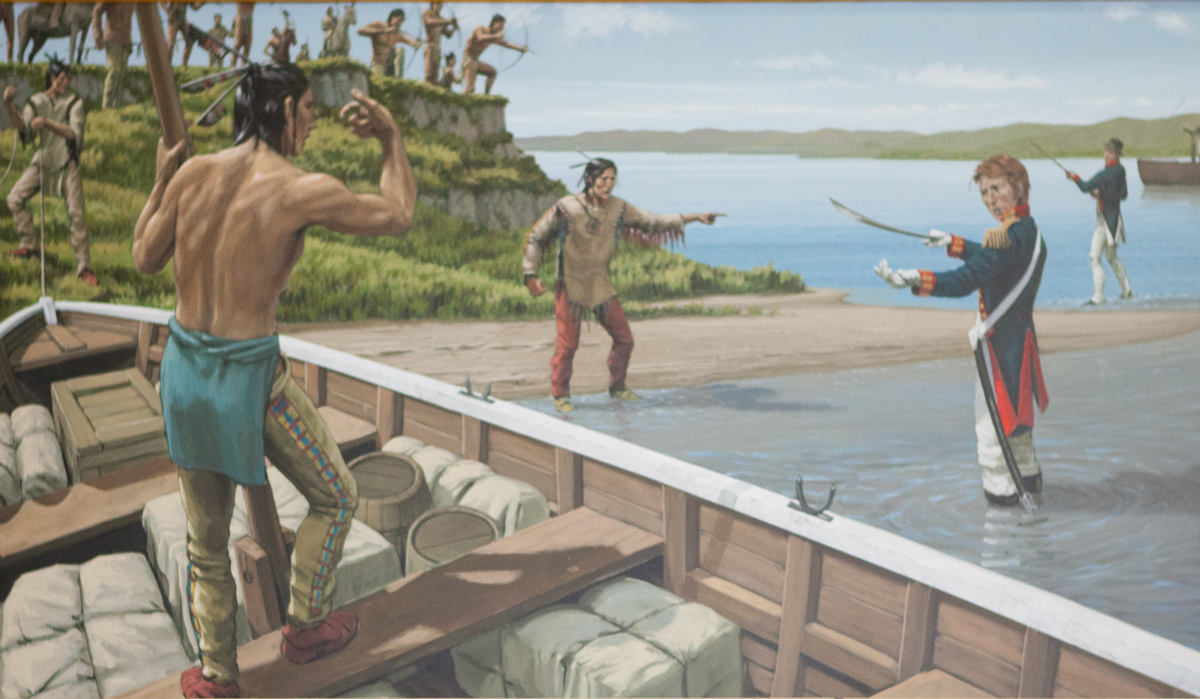
Painting created by Split Rock Studios, Sioux City, Iowa. Original in the collection of the Lewis and Clark Trail Heritage Foundation and photographed by Kristopher K. Townsend.
All Under Arms
as Soon as I landed the Perogue three of their young men Seased the Cable of the Perogue, the Chiefs [Partisan] Soldr. Huged the mast, and the 2d Chief was verry insolent both in words & justures declareing I Should not go on, Stateing he had not recved presents Suffient from us, his justures were of Such a personal nature I felt my Self Compeled to Draw my Sword, at this motion Capt. Lewis ordered all under arms in the boat . . .
—William Clark
On 22 May 1807, a delegation of 24 Sioux Indians met with Superintendent of Indian Affairs William Clark. Among the speechmakers, was Clark’s old nemesis, the Partisan:
2nd, Speech of Tar-to-hon-gar (Partisan) the second chief of the Tetons (who attempted to stop the party sent by [the] Government to explore the Missouri).
My Father: The Chief you made had not the courage to see you. He sent me here to die for my bad conduct towards you and the white children of my great Father.
My Father: The Chiefs and soldiers of my bands sent me here to see you. I was much pushed by my way (alluding to being fired on by the Ottoes) and have not much hopes of getting back to my Nation again.
My Father: There is a man (pointing to Mr. Durion [Pierre Dorion, Sr.], the Sub-agent) you sent with your words. He has delivered them. I have followed him as I meet you here who gave me the heart (medal). I do not wish to go further. If I had not met you here I would follow you to my great father.
My Father: I came here to attend to your words and ask my life of you. Take pity on us and send some person to give life to my Nation.[1]Harry Anderson, “Transcript of William Clark’s Council with the Sioux, 22 May 1807, Saint Louis, Missouri,” South Dakota History 35, no. 1 (2005): 77.
Clark’s views of the Lakota did not change after this counsel. At the end of his smoking soliloquy given to Nicholas Biddle (see September 29, 1804), Clark said, “The Tetons a cunning vicious set.”[2]“The Nicholas Biddle Notes” in Letters of the Lewis and Clark Expedition with Related Documents: 1783–1854, ed. Donald Jackson (Urbana: University of Illinois Press, 1978), 2:517.
Leaving Good Humored Island
I offered my hand to the 1 & 2 Chief who refusd to recve it. I turned off & went with my men on board the pirogue . . . . we proceeded on about 1 mile & anchored out off a willow Island placed a guard on Shore to protect the Cooks & a guard in the boat, fastened the Perogues [pirogues] to the boat, I call this Island bad humered Island as we were in a bad humer.
—William Clark
Weather Diary
Thermot. at rise
Weather Wind at thermotr. at 4 P.M. Weather Wind at 4 oC. P.M 50 fair S. W. 79 fair W. This day the Tetons and ourselves had nearly come to an open a ruptr [rupture]
—Meriwether Lewis[3]To assist the reader, the editor of this web page has omitted the “day of the month” column and spelled out some abbreviations.


Bad River Encounter Site is a High Potential Historic Site along the Lewis and Clark National Historic Trail managed by the U.S. National Park Service. The site is located in Fischers Lilly Park of the city of Fort Pierre.
Notes
| ↑1 | Harry Anderson, “Transcript of William Clark’s Council with the Sioux, 22 May 1807, Saint Louis, Missouri,” South Dakota History 35, no. 1 (2005): 77. |
|---|---|
| ↑2 | “The Nicholas Biddle Notes” in Letters of the Lewis and Clark Expedition with Related Documents: 1783–1854, ed. Donald Jackson (Urbana: University of Illinois Press, 1978), 2:517. |
| ↑3 | To assist the reader, the editor of this web page has omitted the “day of the month” column and spelled out some abbreviations. |
Experience the Lewis and Clark Trail
The Lewis and Clark Trail Experience—our sister site at lewisandclark.travel—connects the world to people and places on the Lewis and Clark Trail.
This page was funded in part by the Lewis and Clark National Historic Trail, U.S. National Park Service.
Discover More
- The Lewis and Clark Expedition: Day by Day by Gary E. Moulton (University of Nebraska Press, 2018). The story in prose, 14 May 1804–23 September 1806.
- The Lewis and Clark Journals: An American Epic of Discovery (abridged) by Gary E. Moulton (University of Nebraska Press, 2003). Selected journal excerpts, 14 May 1804–23 September 1806.
- The Lewis and Clark Journals. by Gary E. Moulton (University of Nebraska Press, 1983–2001). The complete story in 13 volumes.
This site is provided as a public service by the
Lewis and Clark Trail Alliance
with additional funding from the following: