On this rainy day, Lewis and his crew head down the Ohio passing present Little Kanawha and Little Hocking rivers. The barge must be lifted over a gravel bar, and they are further delayed when one of the smaller boats falls behind. They stop for the day near Blennerhassett Island.
Setting Out
Parkersburg, West Virginia
View SSE from Belpre (1909)
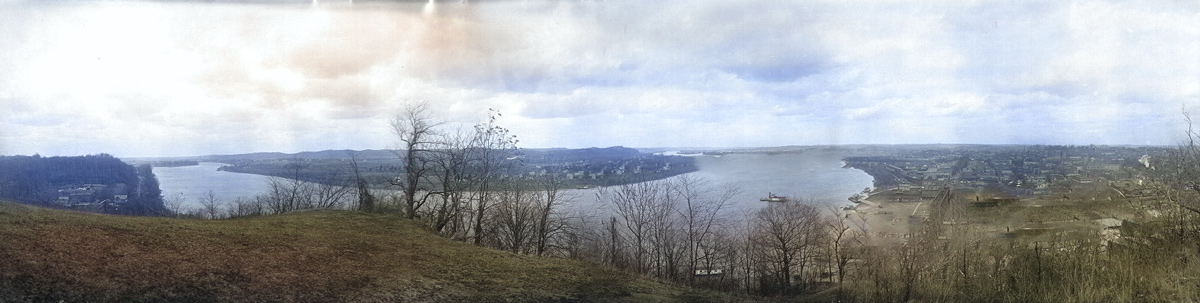
Derived and colorized from the original photo by Haines Photo Co., Library of Congress, loc.gov/pictures/resource/pan.6a16626/.
Set out this morning at sunrise, passed the mouth of the little Kanaway one mile below our encampment of last evening on the Virginia shore it is about 60 yards wide at it’s mouth there is a considerable settlement on this river
—Meriwether Lewis
Rainy Day
one of the canoes fell a considerable distance behind, we were obliged to ly too for her coming up which detained us several hours; it rained very hard on us from 7 this morning untill about three when it broke away and evening as clear with a few flying clouds.
—Meriwether Lewis
Little and Big Hocking Rivers
passed the mouths of the little and big Hockhockin and the settlement of Bellpray—a yanke settlement passed several bad riffles over which we were obliged to lift the boat . . . .
—Meriwether Lewis
Hockhockin [Hockhocking] may be a form of the Delaware term for ‘bottle-gourd place’.[2]William Bright, Native American Placenames of the United States (Norman: University of Oklahoma Press, 2004), 169. Belpre was named by French trappers and derived from Bel Pré, meaning “beautiful meadow” or “beautiful prairie”.[3]“Belpre, Ohio”, Wikipedia, en.wikipedia.org/wiki/Belpre,_Ohio accessed 20 August 2026.
Blennerhassett Island
Blennerhassett Mansion, c. 1800
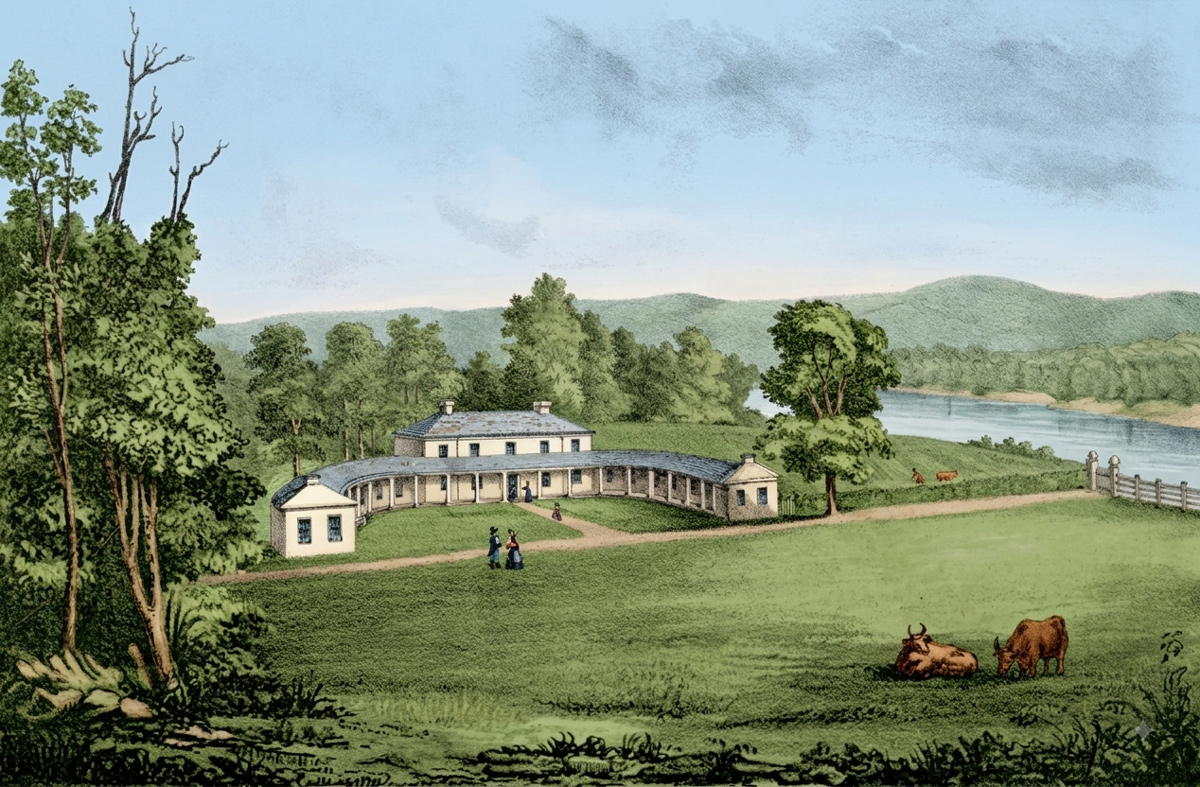
Restored and colorized from the original in the Public Domain.
In 1805, Harman Blennerhassett offered the use of this island to train and outfit Aaron Burr’s expedition. Many suspected Burr was attempting to create an independent country and in 1807, he would be brought to trial for treason. Lewis did not mention this island or the estate when he passed by it on this day. Given his difficulties with riffles, perhaps he did not have time for such a stop. On the expedition’s return home 3 September 1806, the captains were told of the duel between Aaron Burr and Alexander Hamilton and perhaps news of “Burr’s Conspiracy.”
Lewis made no mention of Blennerhassett Island. Just nine days behind Lewis, fellow traveler Thomas Rodney recorded this comment:
The next island we came to was Blaney Hazzards [Harman Blennerhassett], 2 miles below the Little Canaway. The Island as to buildings is very elegantly improved. The dwelling house struck our view as soon as we turned the point of Belleprie.
This Island like all the rest in this river is very rich. The grass in particular is fine on it.
—Thomas Rodney, 24 September 1803[4]Dwight L. Smith and Ray Swick, ed., A Journey Through the West: Thomas Rodney’s 1803 Journal from Delaware to the Mississippi Territory (Athens: Ohio University Press, 1997), 71–72.
Also on this day . . .
Experience the Lewis and Clark Trail
The Lewis and Clark Trail Experience—our sister site at lewisandclark.travel—connects the world to people and places on the Lewis and Clark Trail.
Plan a trip related to September 15, 1803:
Notes
| ↑1 | The Definitive Journals of Lewis & Clark, Gary Moulton, ed. (Lincoln: University of Nebraska Press, 2002), 2:82n1; Hodge, Frederick Webb. Handbook of American Indians North of Mexico (Washington: Smithsonian Institution Bureau of American Ethnology, Government Printing Office, 1912), 1:339. |
|---|---|
| ↑2 | William Bright, Native American Placenames of the United States (Norman: University of Oklahoma Press, 2004), 169. |
| ↑3 | “Belpre, Ohio”, Wikipedia, en.wikipedia.org/wiki/Belpre,_Ohio accessed 20 August 2026. |
| ↑4 | Dwight L. Smith and Ray Swick, ed., A Journey Through the West: Thomas Rodney’s 1803 Journal from Delaware to the Mississippi Territory (Athens: Ohio University Press, 1997), 71–72. |