Near this date, Lewis and company[1]Traveling with Meriwether Lewis to Washington City is a Mandan delegation from the Knife River Villages—Chief Sheheke, his wife Yellow Corn, and their son. Speaking Mandan and French was … Continue reading cross the Rockcastle River, climb up the Rockcastle Hills, and then drop down to Hazel Patch and finally, the Laurel River crossing south of present London, Kentucky. The route changed little between 1750 and 1861.
Elsewhere, news of the Lewis and Clark Expedition’s return to St. Louis reaches Hartford, Connecticut.
Old Road in the Castlerock Hills
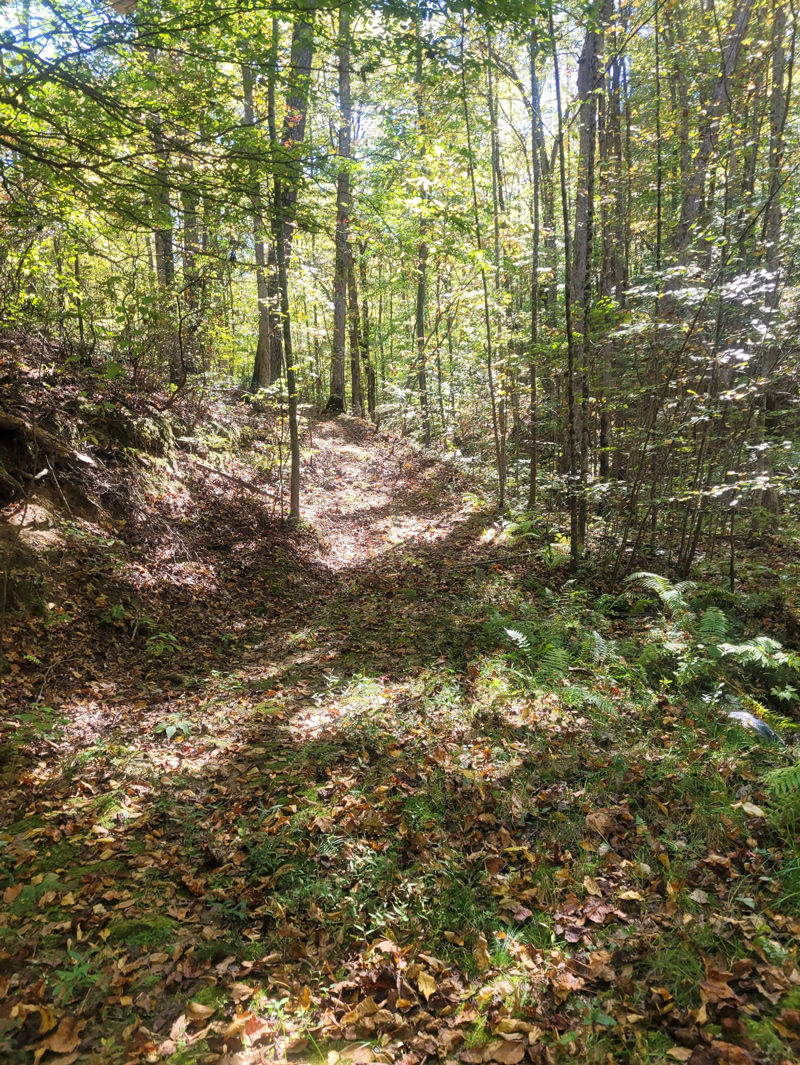
© October 2024 by Casey Smith, shared at Google Maps, maps.app.goo.gl/k3y7ZfGFqsrkXL2r7.
Trail Over the Castlerock Hills (1750)
Antedating Daniel Boone by nearly twenty years, Thomas Walker in 1750 followed the buffalo traces and Native American trails into present Kentucky. In May of that year, he wrote about a trail over the Castlerock Hills—the same trail Lewis and the Mandan delegates would use in 1806. Moving south to north, he recalled the mountains he had traveled over that day.
We got to Lawlesses [Rockcastle] River which is much like the others. The Mountains here are very Steep and on Some of them there is Laurel and Ivy. The tops of the Mountains are very Rocky and some part of the Rocks seem to be composed of Shells, Nuts and many other Substances petrified and cemented together with a kind of Flint.
—Thomas Walker[2]Thomas Walker, Journal of an Exploration in the Spring of the Year 1750 (Boston: Little, Brown, and Company, 1888), 53, available at archive.org/details/journalofexplora00walk.
Wagon Road over Castlerock Hills (1861)
In fall of 1861, Kentucky Union soldiers were encamped on the Wilderness Road atop the Rockcastle Hills. On 21 October, Confederate forces attacked. The battle site is enshrined near Hoosier Knob, and there, one can find traces of the Wilderness Road traveled by Lewis in November 1806—and also Clark in December of that year.
Two miles from Wild Cat they crossed Rockcastle river, a deep mountain stream. From this point the road ascends and winds along by the edge of, and under, the lofty castellated crags, which have given their name, to the river and county . . . .
The camp at Wild Cat was situated on the summit of the lofty range of hills between Big and Little Rockcastle rivers; the road running along this crest is bounded by deep and wild ravines, with precipitous sides . . . .[3]David Stevenson, Indiana’s Roll of Honor, vol. 1 (Indianapolis: A. D. Streight, Publisher, 1864) 537, 538, available at archive.org/details/indianasrollofho01stev. Stevenson collected these … Continue reading
The News Reaches Hartford
Hartford, Connecticut (c. 1836)
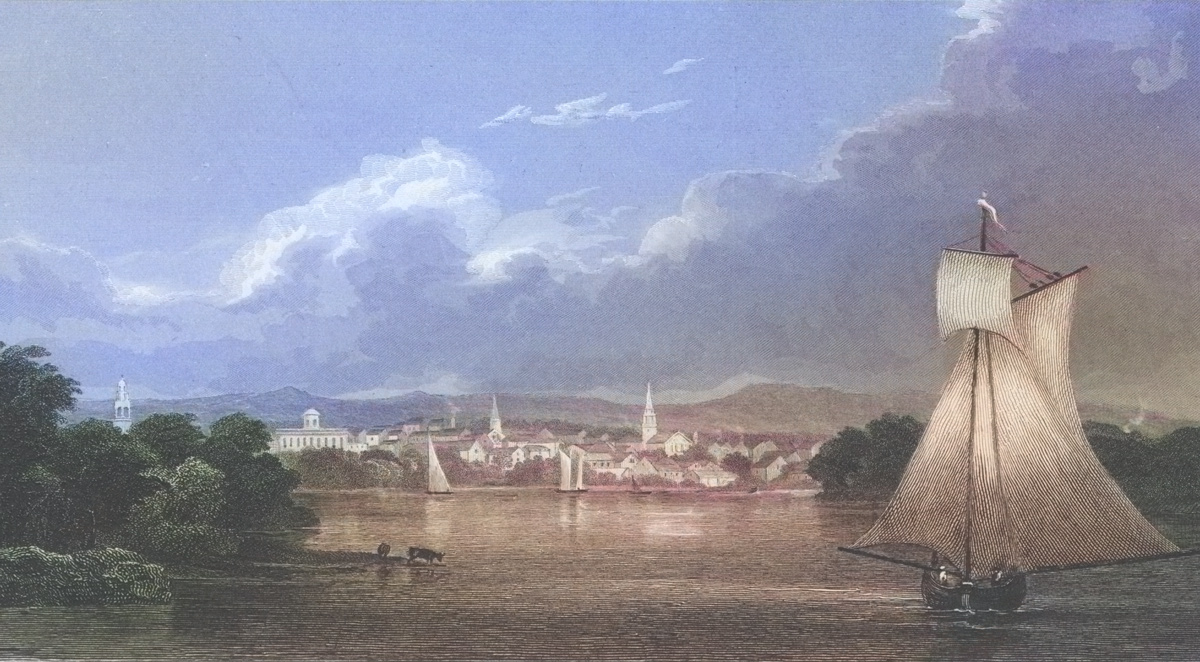
Colorized from the engraving by Fenner Sears & Co. Original drawing by Thomas Cole (1801–1848). Courtesy the Miriam and Ira D. Wallach Division of Art, Prints and Photographs, The New York Public Library, digitalcollections.nypl.org/items/66d4e1a0-c608-012f-771f-58d385a7bc34 accesed 28 Jan 2026.
PHILADELPHIA November 10
More Wonders;—The following extract of a letter is copied from the National Intelligencer. The Rocky mountain sheep [bighorn sheep] beats the horned frog [short-horned lizard] all hollow.
U. S. Gaz. [United States Gazette]
Extract of a letter from a gentleman at St. Charles, to a gentleman in this town dated 23d September 1806.
I have the pleasure to inform you of the arrival of captains Lewis and Clark.
They were the first white people that ever visited that country. By the best accounts they could get, there are about ninety or one hundred thousand inhabitants, (Indians) on the west side of the Rocky Mountains: horses without number. It is thought to be a very poor Indian that did not own 300 horses. Not an iron tool among them. They erected a fort on the sea shore, and engraved their names. They have brought a number of curiosities; among which is a wild sheep: its head and horns weigh about 80 or 90 pounds. He was caught on the Rocky Mountains.[4]Hartford Courant, 19 November 1806, page 2.
Notes
| ↑1 | Traveling with Meriwether Lewis to Washington City is a Mandan delegation from the Knife River Villages—Chief Sheheke, his wife Yellow Corn, and their son. Speaking Mandan and French was interpreter René Jusseaume who brought one of his wives and two children. Expedition private François Labiche was included to translate between French and English. Finally, records indicate expedition sergeant John Ordway was serving as Lewis’s assistant. |
|---|---|
| ↑2 | Thomas Walker, Journal of an Exploration in the Spring of the Year 1750 (Boston: Little, Brown, and Company, 1888), 53, available at archive.org/details/journalofexplora00walk. |
| ↑3 | David Stevenson, Indiana’s Roll of Honor, vol. 1 (Indianapolis: A. D. Streight, Publisher, 1864) 537, 538, available at archive.org/details/indianasrollofho01stev. Stevenson collected these descriptions by interviewing officers and soldiers in the Illinois 33rd Infantry Regiment. |
| ↑4 | Hartford Courant, 19 November 1806, page 2. |
Experience the Lewis and Clark Trail
The Lewis and Clark Trail Experience—our sister site at lewisandclark.travel—connects the world to people and places on the Lewis and Clark Trail.
Discover More
- The Lewis and Clark Expedition: Day by Day by Gary E. Moulton (University of Nebraska Press, 2018). The story in prose, 14 May 1804–23 September 1806.
- The Lewis and Clark Journals: An American Epic of Discovery (abridged) by Gary E. Moulton (University of Nebraska Press, 2003). Selected journal excerpts, 14 May 1804–23 September 1806.
- The Lewis and Clark Journals. by Gary E. Moulton (University of Nebraska Press, 1983–2001). The complete story in 13 volumes.
This site is provided as a public service by the
Lewis and Clark Trail Alliance
with additional funding from the following: