Near this date, Lewis and company[1]Traveling with Meriwether Lewis to Washington City is a Mandan delegation from the Knife River Villages: Chief Sheheke, his wife Yellow Corn, and their son. Speaking Mandan and French was interpreter … Continue reading travel on the Wilderness Road between the Laurel River and the broad Cumberland River valley. Situated halfway between Corbin and Pineville, Barboursville was a common stop on the Wilderness Road, and Richard Ballinger’s tavern—built c. 1795—was considered the best inn between Crab Orchard and the Cumberland Gap.[2]Robert L. Kincaid, The Wilderness Road (Indianapolis: The Bobbs-Merrill Company, 1947), 196, available at archive.org/details/wildernessroad00kinc. In April 1750, Thomas Walker named and described the Cumberland River, and his party built a cabin near Barboursville.
The Cumberland River
Cumberland River
Daniel Boone National Forest
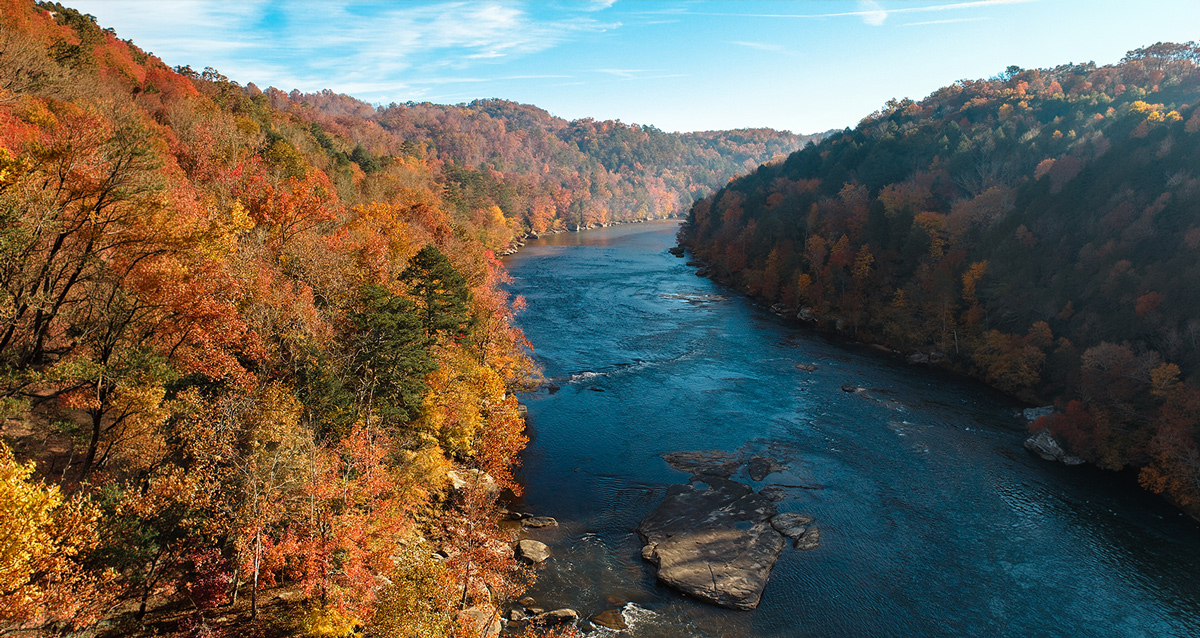
Generated from an original photo created by Ben Childers for the U.S. National Forest. Image is in the Public Domain.
In 1750, Thomas Walker found the Cumberland River difficult to ford and saw several trees with their bark stripped off:
On the other side of the River is a large Elm cut down and barked about 20 feet and another standing just by it with the Bark cut around at the root and about 15 feet above. About 200 yards below there is a white Hiccory Barked about 15 feet. The depth of water here, when the lowest that I have seen it, is about 7 or 8 feet, the Bottom of the River Sandy, ye Banks very high, & the Current very Slow.
—Thomas Walker, 30 April 1750[3]Thomas Walker, Journal of an Exploration in the Spring of the Year 1750 (Boston: Little, Brown, and Company, 1888), 50, available at archive.org/details/journalofexplora00walk.
On the Holston River, 31 March, Walker “measured an Elm 25 feet round”. This elm had a diameter of eight feet. The availability of these large trees supports the theory that the pirogues of the Lewis and Clark Expedition were carved from logs, not rowboats made from planked wood.[4]Thomas Walker, Journal, 43. For more on pirogues dugout from massive old growth trees, see John W. Fisher, “The Pirogue”, Museum of the Fur Trade Quarterly 48, no. 3 (Fall 2012): 1–13.
Thomas Walker’s Cabin
Barbourville, Kentucky Today
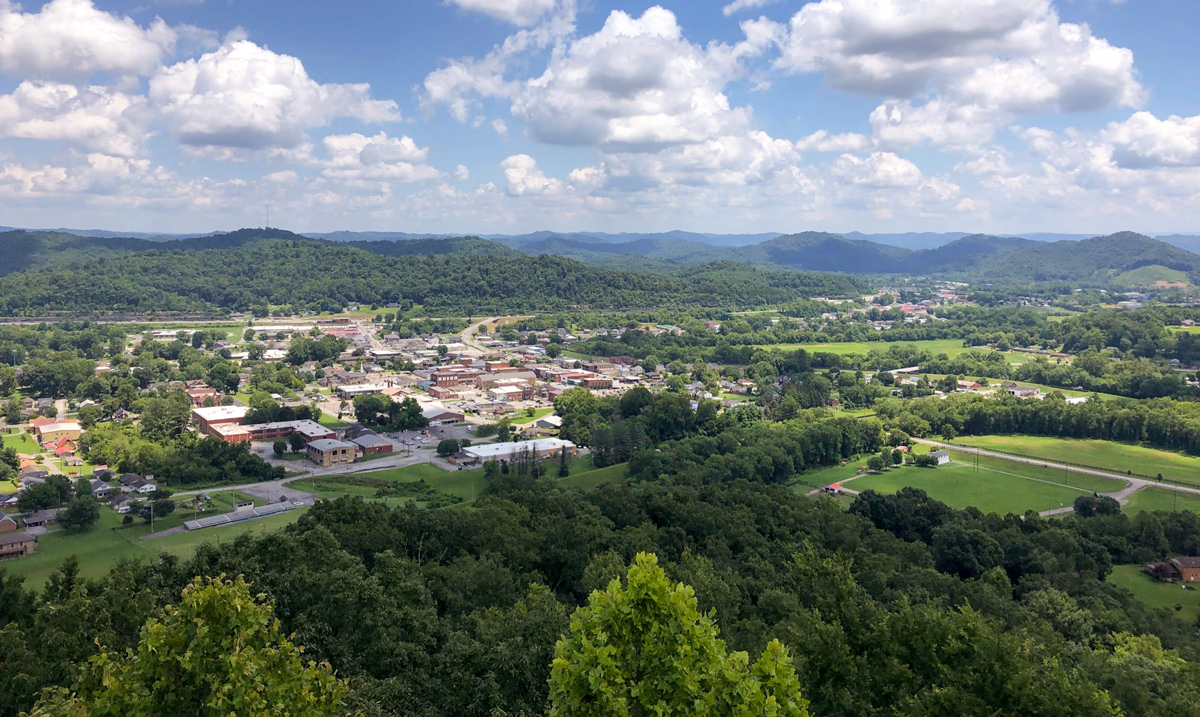
Submitted to Google Maps by B “Doomed 5G” M, July 2019, maps.app.goo.gl/SY8pzE58ARBZDor98.
Near present Barboursville, Walker left half his party to build a base-camp for future explorations:
[22 Apr 1750] I then Propos’d that with 2 of the Company I would proceed, and the other three should Continue here till our return . . . .
[23 Apr 1750] Having carried our Baggage over in the Bark Canoe, and Swam our horses, we all Crossed the [Cumberland] River. Then Ambrose Powell, Colby Chew, and I departed, Leaving the others to provide and salt some Bear, build an house, and plant some Peach Stones and Corn.
[28 Apr 1750] The People I left had built an House 12 by 8, clear’d and broke up some ground, & planted Corn, and Peach Stones. They also had killed several Bears and cured the meat.
—Thomas Walker[5]Thomas Walker, Journal, 47, 50.
First Kentucky Houses
Walker’s cabin may have been the first English house in Kentucky, but Walker himself tells of houses pre-dating his:
[27 Apr 1750] We crossed Indian Creek and Went down Meadow Creek to the River. There Comes in another from the Southward as big as this we are on. Below the mouth of this Creek, and above the mouth are the remains of Several Indian Cabbins and amongst them a round Hill made by Art about 20 feet high and 60 over the Top.
—Thomas Walker[6]Thomas Walker, Journal, 49.
Walker’s Route
Journey of Dr. Thomas Walker and Five Associates
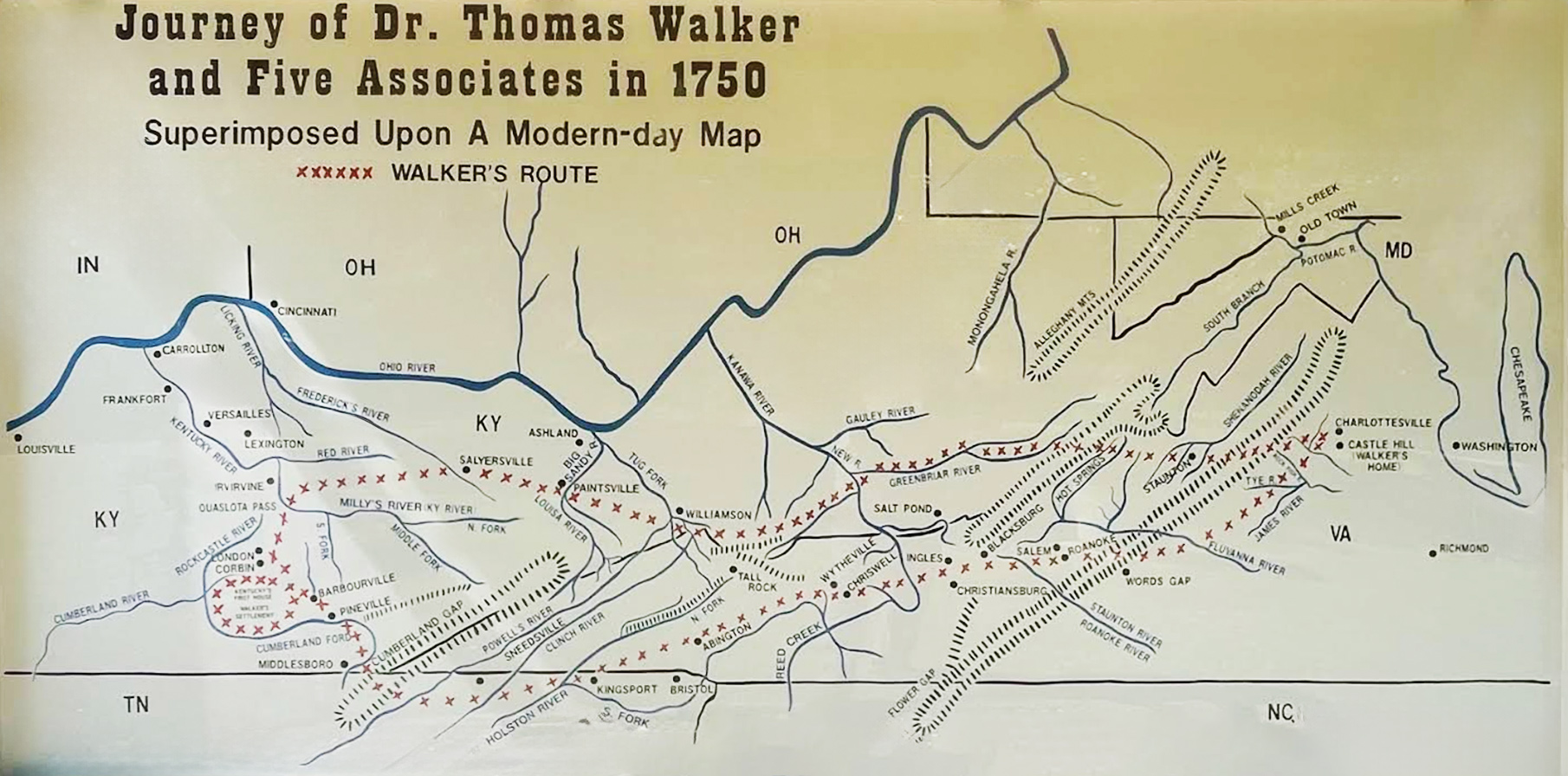
Interpretive panel at Dr. Thomas Walker State Historic Site.
Walker’s party left their cabin on 20 June 1750 and returned home through present West Virginia.[7]Kentucky: A Guide to the Bluegrass State: compiled and written by the Federal Writers’ Project of the Work Project Administration for the State of Kentucky (New York: Harcourt, Brace and … Continue reading
Notes
| ↑1 | Traveling with Meriwether Lewis to Washington City is a Mandan delegation from the Knife River Villages: Chief Sheheke, his wife Yellow Corn, and their son. Speaking Mandan and French was interpreter René Jusseaume who brought one of his wives and two children. Expedition private François Labiche was included to translate between French and English. Finally, records indicate expedition sergeant John Ordway was serving as Lewis’s assistant. |
|---|---|
| ↑2 | Robert L. Kincaid, The Wilderness Road (Indianapolis: The Bobbs-Merrill Company, 1947), 196, available at archive.org/details/wildernessroad00kinc. |
| ↑3 | Thomas Walker, Journal of an Exploration in the Spring of the Year 1750 (Boston: Little, Brown, and Company, 1888), 50, available at archive.org/details/journalofexplora00walk. |
| ↑4 | Thomas Walker, Journal, 43. For more on pirogues dugout from massive old growth trees, see John W. Fisher, “The Pirogue”, Museum of the Fur Trade Quarterly 48, no. 3 (Fall 2012): 1–13. |
| ↑5 | Thomas Walker, Journal, 47, 50. |
| ↑6 | Thomas Walker, Journal, 49. |
| ↑7 | Kentucky: A Guide to the Bluegrass State: compiled and written by the Federal Writers’ Project of the Work Project Administration for the State of Kentucky (New York: Harcourt, Brace and Company, 1939), 36, available at archive.org/details/in.ernet.dli.2015.59837. |
Experience the Lewis and Clark Trail
The Lewis and Clark Trail Experience—our sister site at lewisandclark.travel—connects the world to people and places on the Lewis and Clark Trail.
Discover More
- The Lewis and Clark Expedition: Day by Day by Gary E. Moulton (University of Nebraska Press, 2018). The story in prose, 14 May 1804–23 September 1806.
- The Lewis and Clark Journals: An American Epic of Discovery (abridged) by Gary E. Moulton (University of Nebraska Press, 2003). Selected journal excerpts, 14 May 1804–23 September 1806.
- The Lewis and Clark Journals. by Gary E. Moulton (University of Nebraska Press, 1983–2001). The complete story in 13 volumes.
This site is provided as a public service by the
Lewis and Clark Trail Alliance
with additional funding from the following: