At Cincinnati, Ohio, Lewis rests his crew and arranges to collect fossils at Big Bone Lick. Perhaps he peruses yesterday’s Western Spy which runs Aviator’s “Notes on the Missouri” that fills the entire first page.[1]As of this writing, the identity of Viator—a common pen name from the Latin for voyageur—is unknown to this author. Page two announces the expedition of “Capt. Clark and Mr. Lewis”.
Near Natchez, the governor of the Mississippi Territory William Claiborne updates President Jefferson regarding the Louisiana Territory and Thomas Rodney.
The Western Spy, and Hamilton Gazette
Cincinnati, Wednesday, September 28, 1803
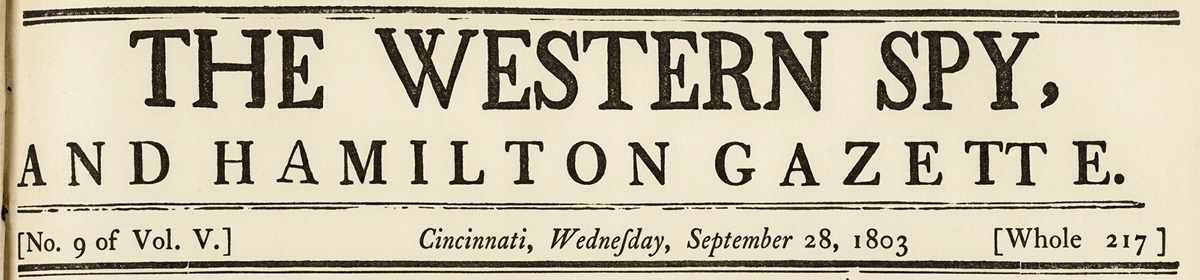
Touched up from the original at newspapers.com
The Grand Detour
About two hundred leagues further up the Missouri, that is, beyond the Plate’s [Platte River] mouth; there is a remarkable bend called the Grand Detour, concerning the extent and position of which my informants were not perfectly agreed; some making it describe a circuit of 30 or 40 leagues; but Mr. C [Chouteau]—in whose intelligence I place great confidence, affirms that it does not exceed eighteen leagues. Be that as it may—the beginning & end of this bend approach so near to each other, that a man can walk across the neck between them in half a day—whereas it takes up 8 or 9 days to row up stream, around it.
—Viator[2]The Western Spy, and Hamilton Gazette (Cincinnati, Ohio), 28 September 1803, page 1.
Sulfurous Volcano
In the neighbourhood of the Grand Detour and about ten leagues from the river, on its northern side, there is a very lofty volcanic mountain, which is frequently in a state of erruption. This will account for the pumice stones so often found floating down the Missouri, and Lower Missisippi. To this volcano may be attributed a smart shake of an earthquake, felt at Kaskaskia, &c. at 3 o’clock in the morning, January 8th, 1795, and which came in an apt direction from the mountain.†
†Some years after the above was written, certain travellers proceeded to the mountain, and found it raging. They could not approach within a mile of it, for fear of suffocation, from the sulphurous fumes it sent fourth.
—Viator[3]Ibid.
Difficulties and Dangers
The navigation of the Missouri is attended with difficulty and danger; danger, from its numerous quicksands, and difficulty from the obstinacy of its current. The quicksands lie sometimes in shoal water, & sometimes form dry bars, or islands of various extent. If a boat happen to strike on one of the former, it is usual for the hands instantly to leap into the water, and push her off. Without this precaution, the sand would quickly boil over both bows and gunwales, and swallow up the boat.
—Viator[4]Ibid.
The Expedition of Capt. Clark and Mr. Lewis
WASHINGTON, (K.y) Sept. 8.
In the Louisville paper of the [August] 25th ult. we find the following paragraph.
“An expedition is expected to leave this place shortly, under the direction of capt. William Clark & Mr. Lewis, (private secretary to the President) to proceed through the immense wilderness of Louisiana to the Western or pacific Ocean. The particular objects of this undertaking are, at present, matters of conjecture only: But we have good reason to believe that our government intend to encourage settlements and establish seaports on the coast of the pacific ocean, which would not only facilitate our whaling and sealing voyages, but enable our merchants to carry on a more direct and rapid trade with China and the East indies.”[5]Ibid., page 2.
Claiborne’s Update
Near Natchez
September the 29th 1803Dear Sir,
The Surveyor General Mr Briggs has established his office in the Town of Washington, and added greatly to the happiness of our little society; I hold him in high estimation, and discover with pleasure, that he is acquiring very fast the esteem and confidence of the people. Mr Rodney and Mr Williams have not yet arrived; their appointments as commissioners are very popular, and they are themselves great acquisitions to the Territory.
The form of Government which may be prescribed for our new Territory, excites great anxiety in this quarter. . . . I am inclined to an opinion, that until a knowledge of the American Constitutions, Laws, Language and customs, is more generally diffused, a state Government in Louisiana, would not be managed with descretion.
William C. C. Claiborne[6]“To Thomas Jefferson from William C. C. Claiborne, 29 September 1803,” Founders Online, National Archives, https://founders.archives.gov/documents/Jefferson/01-41-02-0325. [Original … Continue reading
Experience the Lewis and Clark Trail
The Lewis and Clark Trail Experience—our sister site at lewisandclark.travel—connects the world to people and places on the Lewis and Clark Trail.
Plan a trip related to September 29, 1803:

Notes
| ↑1 | As of this writing, the identity of Viator—a common pen name from the Latin for voyageur—is unknown to this author. |
|---|---|
| ↑2 | The Western Spy, and Hamilton Gazette (Cincinnati, Ohio), 28 September 1803, page 1. |
| ↑3 | Ibid. |
| ↑4 | Ibid. |
| ↑5 | Ibid., page 2. |
| ↑6 | “To Thomas Jefferson from William C. C. Claiborne, 29 September 1803,” Founders Online, National Archives, https://founders.archives.gov/documents/Jefferson/01-41-02-0325. [Original source: The Papers of Thomas Jefferson, vol. 41, 11 July–15 November 1803, ed. Barbara B. Oberg. Princeton: Princeton University Press, 2014, pp. 427–429.] |