Anchored on a large sandbar, the night is dry and the morning clear, and the crews set out before sunrise. The barge is safely piloted through the rapids at Letart Falls. Here, Lewis’s journal ends until November 11. Fortunately, Zadok Cramer and Thomas Rodney also describe the rapid they called Letart’s Falls.
Passing Letart Falls
Letart Falls of the Ohio (simulated)
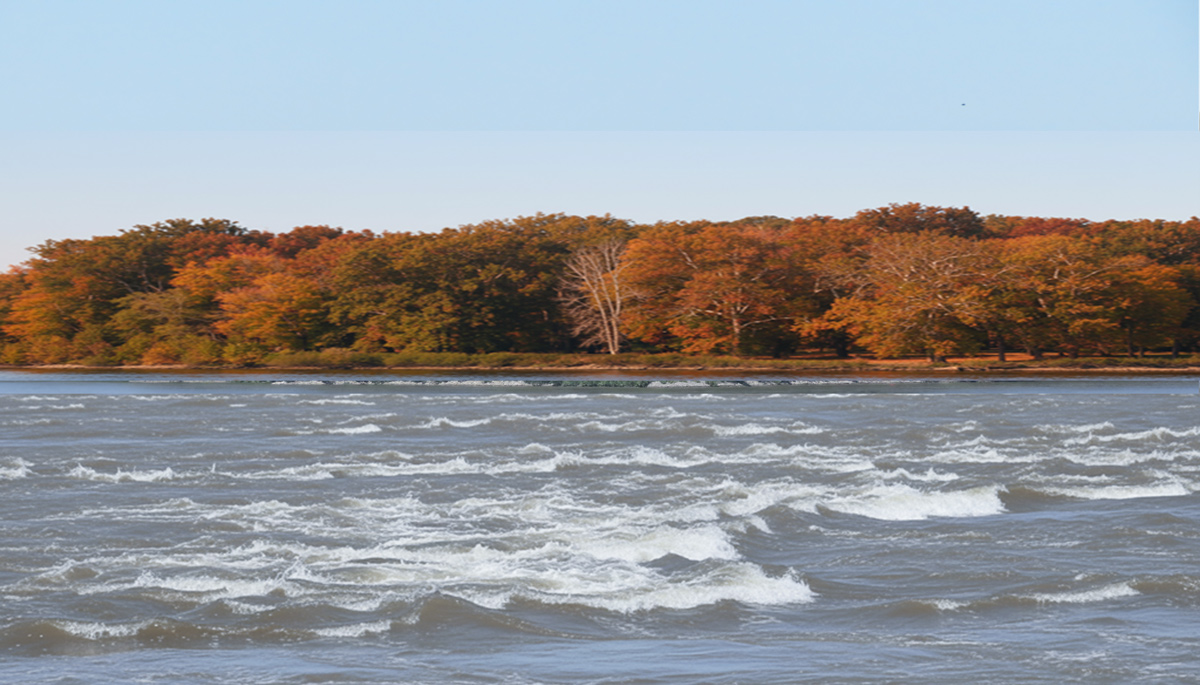
Generated from the original © 2021 by Robert Heacock. Used by permission.
In 1803, navigators typically called any rapid a “fall” in the river.
we set out before sunrise and at nine in the morning passed Letart’s falls . . . . this rappid is the most considerable in the whole course of the Ohio, except the rappids as they ar called opposite to Louisville in Kentuckey— the descent at Letart’s falls is a little more than 4 four feet in two hundred fifty yards.
—Meriwether Lewis
Rodney’s Experience
On 27 September 180—nine days after Lewis—Thomas Rodney successfully navigated the rapids at Letart Falls. He found the passage easy and regretted having hired a local river pilot:
[T]he torrent and the white caps over the falls was a sufficient direction. There was no danger but one large rock in the midst of the falls, which was easily seen; and the Ohio Pilot directed us close on the left of it, which road our pilot kept, and we were over them in an instant; and when safe we set the pilot ashore, and gave him 3/9 for his trouble.
—Thomas Rodney[1]Dwight L. Smith and Ray Swick, ed., A Journey Through the West: Thomas Rodney’s 1803 Journal from Delaware to the Mississippi Territory (Athens: Ohio University Press, 1997), 78.
Rodney paid the pilot 45 pence—3 shillings and 9 pence. His “Ohio Pilot” is a reference to the description in Cramer’s Navigator shown and transcribed below. In normal water conditions, the large rock was underwater creating a potential unseen water hazard. Here, Lewis and Rodney benefited from the low water conditions by exposing this hidden hazard. The rocks creating the rapids were later removed, and in Cramer’s 1814 description, there is no mention of it.[2]Zadok Cramer, The Navigator: Containing Directions for Navigating the Monongahela, Allegheny, Ohio and Mississippi Rivers . . . (Pittsburgh: Cramer, Spear and Eichbaum, 1814), 91.
Cramer’s Description (1802)
Cramer’s Description in 1802
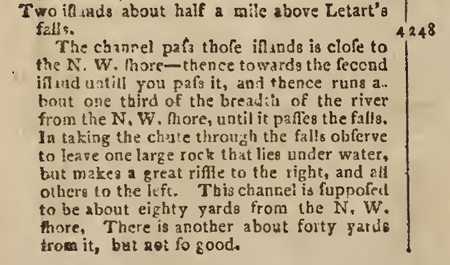
Zadok Cramer, The Navigator, 1802, from archive.org, accessed on 24 December 2018.
Two islands about half a mile above Letart’s falls. 248 [miles]
The channel pass those islands is close to the N. W. shore—thence towards the second island untill you pass it, and thence runs about one third of the breadth of the river from the N. W. shore, until it passes the falls. In taking the chute through the falls observe to leave one large rock that lies under water, but makes a great riffle to the right, and all others to the left. This channel is supposed to be about eighty yards from the N. W. shore. There is another about forty yards from it, but not so good.[3]Zadok Cramer, The Navigator: Containing Directions for Navigating the Monongahela, Allegheny, Ohio and Mississippi Rivers… (Pittsburgh: Zadok Cramer, Bookseller & Stationer, 1802), 28.
Experience the Lewis and Clark Trail
The Lewis and Clark Trail Experience—our sister site at lewisandclark.travel—connects the world to people and places on the Lewis and Clark Trail.
Plan a trip related to September 18, 1803:

Notes
| ↑1 | Dwight L. Smith and Ray Swick, ed., A Journey Through the West: Thomas Rodney’s 1803 Journal from Delaware to the Mississippi Territory (Athens: Ohio University Press, 1997), 78. |
|---|---|
| ↑2 | Zadok Cramer, The Navigator: Containing Directions for Navigating the Monongahela, Allegheny, Ohio and Mississippi Rivers . . . (Pittsburgh: Cramer, Spear and Eichbaum, 1814), 91. |
| ↑3 | Zadok Cramer, The Navigator: Containing Directions for Navigating the Monongahela, Allegheny, Ohio and Mississippi Rivers… (Pittsburgh: Zadok Cramer, Bookseller & Stationer, 1802), 28. |