Near this date, Lewis likely stops in Maysville, Kentucky near the home of John Colter who served admirably as a private in the expedition and would later become famous for his life as a mountain man. Thomas Rodney describes the town, a boat being built there, and expresses a low opinion of Ohio River settlers.[1]Due to a gap in Lewis’s journal, his exact location for this day is unknown. He was at Letart Falls on 18 September and arrived in Cincinnati on 28 September. Based on Thomas Rodney’s … Continue reading
Maysville
Maysville, Kentucky (c. 1821)
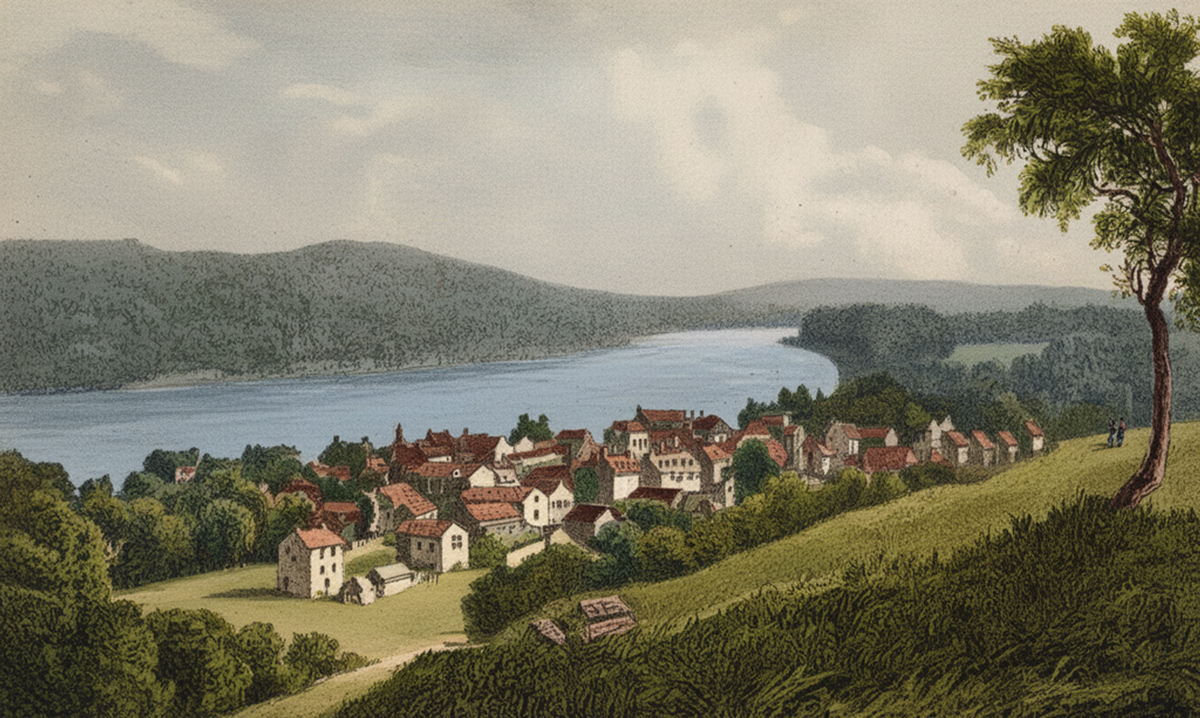
Colorized from Adlard Welby, A Visit to North American and the English Settlements in Illinois (London: 1821), p. 68, available at www.archive.org/details/visittonorthamer00welb.
The town of Limestone is called Maysville. I do not know why. This place is a great thorofare and more might be expected of it than it seen. There is about 50 houses in the town and a few large good houses but I observed but one of brick.
—Thomas Rodney, 3 October 1803[2]Dwight L. Smith and Ray Swick, ed., A Journey Through the West: Thomas Rodney’s 1803 Journal from Delaware to the Mississippi Territory (Athens: Ohio University Press, 1997), 93,94.
Mr. Gallahar’s Boat
Mr. Gallahar has a very fine ship of about 2450 tuns on the stocks and will be done by the swell of the river. We viewed her and she appears to be well built and of excellent stuff such as mulberry, locust, white oak. etc.
—Thomas Rodney, 3 October 1803[3]Ibid.
Low Opinion
[T]he present disposition of the people on this beautiful river is very unfavorable to its improvement. They mostly seem as if they were only waylayers to take advantage of travelers intead of aiding and incurraging the navigation of the river.
—Thomas Rodney, 3 October 1803[4]Ibid., 94.
John Colter
John Colter was born about 1775 and family tradition has him leaving the family farm in Staunton, Virginia and settling in Limestone on the Ohio River—after 1785 officially known as Maysville, Kentucky—sometime prior to the arrival of Lewis and the boats in late September 1803.[5]Stallo Vinton, John Colter: Discoverer of Yellowstone Park (New York: Edward Eberstadt, 1926), 27–29. The blue-eyed young man, 5’10” tall, approached Captain Lewis about joining the expedition. His official enlistment in the U.S. Army’s First Regiment began 15 October 1803 at the Falls of the Ohio.[6]Donald Jackson, ed. Letters of the Lewis and Clark Expedition with Related Documents: 1783-1854, 2nd ed. (Urbana: University of Illinois Press, 1978), 2:378. See also Thwaites, Reubin G. Original … Continue reading
On the way home in 1806, Colter was discharged so that he could head west with two fur trappers. He was the first known person of European descent to explore what become Yellowstone National Park, and he would make an epic escape from the Blackfeet—known today as Colter’s Run. His exploits have become a part of the story of the American West and Rocky Mountain Fur Trade era. See more at John Colter.
Experience the Lewis and Clark Trail
The Lewis and Clark Trail Experience—our sister site at lewisandclark.travel—connects the world to people and places on the Lewis and Clark Trail.
Plan a trip related to September 24, 1803:
Notes
| ↑1 | Due to a gap in Lewis’s journal, his exact location for this day is unknown. He was at Letart Falls on 18 September and arrived in Cincinnati on 28 September. Based on Thomas Rodney’s journal of his similar trip down the Ohio and Cramer’s 1802 river guide, The Navigator, one conjecture is that Lewis stopped for a night or two at Maysville. |
|---|---|
| ↑2 | Dwight L. Smith and Ray Swick, ed., A Journey Through the West: Thomas Rodney’s 1803 Journal from Delaware to the Mississippi Territory (Athens: Ohio University Press, 1997), 93,94. |
| ↑3 | Ibid. |
| ↑4 | Ibid., 94. |
| ↑5 | Stallo Vinton, John Colter: Discoverer of Yellowstone Park (New York: Edward Eberstadt, 1926), 27–29. |
| ↑6 | Donald Jackson, ed. Letters of the Lewis and Clark Expedition with Related Documents: 1783-1854, 2nd ed. (Urbana: University of Illinois Press, 1978), 2:378. See also Thwaites, Reubin G. Original Journals of the Lewis and Clark Expedition 1804–1806 (New York: Dodd, Mead & Company, 1905), 360–361. |